Showing posts with label Doctrine. Show all posts

Wednesday, February 1, 2017

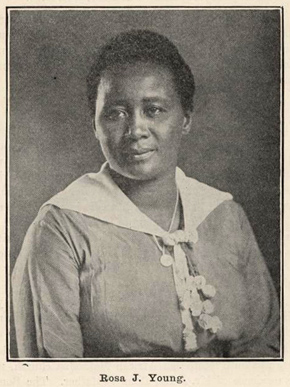
Rosa Young - Tramping for the Lord!


     Rosa Young's book, "Light in the Dark Belt," is a great inspiration to me. Her story is a great example of Hebrews 12.1: "Since we are surrounded by so great a cloud of witnesses, let us lay aside every weight and the sin which so easily entangles us, and let us run with endurance the race set before us."

     She was born in 1890 in Rosebud, Alabama. Her father was an African Methodist pastor. Her mother was a  woman of high moral character and a great encouragement to her. She, along with so many in the post-war south, lived through great poverty. She describes the huts and cabins in which people lived, the ragged clothing, and the poor table fare eaten from tin pans and buckets with fingers.

     Worse than this was the spiritual and educational situation of the people. Here is her description of the spiritual conditions:

I knew something was wrong with the kind of religion my people had, but I did not know what was wrong about it. I desired a better Christian training for myself and my people, but I did not know where to find it. The religion of my people was a mere pretense, a kind of manufactured religion. Those who belonged to church were no better than those who did not. In most of the homes the so-called Christian families as well as the unbelievers lived in envy, strife, malice, prejudice, bitter hatred, yea, hellish riot; in covetousness; in adultery and fornication; in theft and lying.


In hundreds of homes the Bible was never read, a prayer was never spoken, and a Christian hymn was never sung. The whole family lay down at night and rose the next morning, and each went out to do his work without saying a word of thanks to God. Sin was looked upon by most people as a small thing. They held divine services in their churches twelve times a year, on the average once a month. No one took the time to teach them Christian hymns; they sang old plantation songs during their services.

     Rosa was a good student who loved learning. With encouragement and help she was able to graduate from Payne University in Selma, Alabama in 1909 to become a school teacher. She advocated relentlessly for education and worked hard to raise the educational standards of the children in southern Alabama. 

     The 1914 Boll Weevil infestation of the Alabama Black Belt (named for the soil color) wreaked havoc and made Rosa's educational efforts difficult. But this proved to be a blessing in disguise. Rosa wrote to Booker T. Washington of the Tuskegee Institute for help. He wrote back telling her that his funds were exhausted, but that she should contact the Lutheran Church-Missouri Synod in St. Louis. They might be able to help. They sent Rev. Nils J. Bakke, who began helping Rosa with her education and mission efforts. Along with help from other pastors, Rosa eventually founded 30 Lutheran schools and 35 Lutheran congregations. 

     I am especially impressed and encouraged by Rosa's concern for the Bible and true doctrine. She was not a missionary with a lot of zeal and very little doctrine. Like the Apostle Paul, she was both zealous and devoted to the truth of God's word and particularly to the Gospel message of forgiveness in Christ, crucified and risen. Rosa's method was to go out and visit. She wrote, 

Visiting is the key to success in mission work. It unlocks the door of opportunity where you may enter many a home and tell the people the old, old story of Jesus and His love.

And again,

During the summer months, when I was not teaching school, I made it a rule to visit every home in the community and also in the adjacent communities, both Lutheran and non-Lutheran. I made a list of the names of the people who did not belong to, or attend, any church. Such people I called my mission-material, and I endeavored by the help of the Lord to get them into my Church. As it was summertime, I would find the people mostly in the fields. Many times they worked miles away from their homes; but no matter where they were or who they were, men, women, or children, I would find them and deliver my Bible message to them.

I hunted lost souls for Jesus somewhat as I hunted for money to build and maintain my first school. I endeavored to tell this Bible message to every person I saw that day. No matter how long it took me to work up to the point in our chat or conversation where I could deliver my Bible verse, I would deliver it. When I had told my message to one person, I would proceed to another. I walked in prayer all along the way from one person to another, asking the Lord to bless the message of His Word as I delivered it.

    I think what I will remember most about Rosa is a comment by one of her relatives. After Rosa had recovered from an illness and was preparing to continue her work, her relative asked: “Are you going back to tramping again?” To which Rosa replied: “Oh, don’t call it tramping! I am going back to save souls for Jesus.”


Saturday, July 6, 2013

Why I Voted for Matthew Harrison for President of the LCMS

Three years ago I explained why I voted for Matt Harrison at the Synodical Convention in Houston. President Kieschnick had led the Synod for nine years and seemed likely to continue.  He complained that he didn't have the authority he needed to lead the Synod since he was hampered by the gridlock of program boards that opposed his agenda and sometimes stepped on each other. There was some truth to that. But the structural overhaul of the Synod that Kieschnick was pushing gave too much power to the president in my opinion.  To the amazement of many the Synod began to approve the overhaul and then elected a new president - Matt Harrison!  

Structural overhauls of organizations are needed from time to time, but the structure of an organization doesn't necessarily bring healing to its problems... especially when those problems are spiritual in nature.  What are those problems?  I'm sure there are many ways to approach this, but the one problem that really concerns me is the tension between maintaining correct theology and carrying out the mission of the church.  

Some say we spend too much time debating doctrinal issues and not enough time focused on living out the faith and proclaiming it.  Others are concerned that we are letting errors creep into the church, and, if left unchecked, our proclamation will be wrong and won't matter anyway.  President Kieschnick tended toward the former. President Harrison tends toward the latter.  

I have cautiously tended toward the latter when it comes to this tension.  In my mind all problems in the church are ultimately theological because all ministry arises from God's word (theo-God, logical-word).   I do value the resources we can find for ministry in the world of business, psychology, and sociology. I also want those on the other side of this equation to know that I am listening. I'm interested in your evaluations and criticisms. I work very hard for the ministry to which I have been called, and I am very concerned about fulfilling the mission the Lord has given us.

Unfortunately those criticisms (of the theological/confessional priority) are often vague or anonymous.  A few years ago I was involved in a meeting of our synodical leadership in which a ministry of our church was accused of being "divisive." I asked how so? I received blank stares. True Christian ministry must be divisive at times. The only question is whether or not it is unnecessarily divisive. To determine that we need to get to the specifics.

On the other hand I have seen how the title "confessional" can become a shield which some use to hide a lazy or limited ministry.  The first thing my father told me when I said I was thinking about studying for the ministry was, "Just make sure you work forty hours a week." I absolutely love to study God's word, and frankly I do have a temptation to do that instead of sharing it in the most effective ways. But this is also a theological problem, and it is one that we need to discuss in Christian truth and love.

Brothers and sisters in Christ, my biggest fear of all is what I believe is the inevitable pressure of persecution coming to Christians in America.  I am fearful that some will be too willing to compromise with the world for the sake of the mission.  But I am equally fearful that we might be so slack in our labors of love that the world will dismiss us as hypocrites.

The Scriptures point us to the importance of both. "Mercy and truth have met together; Righteousness and peace have kissed" (Psalm 85.10).  "You shall love the Lord your God with all your heart, mind and soul... You shall love your neighbor as yourself" (Matthew 22.37, 39). In this election, like the last, I voted for Matt Harrison. Nevertheless I fervently pray that God will help us to have the priority of both, mercy and truth, at all times. 


Wednesday, April 15, 2009

Pick a Church Any Church?


Here in Collinsville we just finished an interesting program started by the Collinsville Area Ministerial Alliance. It was called "Pick a Church, Any Church." It was a big marketing campaign designed to get people to church for Easter. Seventeen congregations (GLSC included) kicked in $$$ to buy signs, print fliers, pay for ads, billboards, an automated call from Mayor John Miller, and an automated call from Congressman John Shimkus. Some of our members wondered about this program. "Pick a Church, Any Church?" That didn't sound like GSLC. They thought it should be "Pick a Church, My Church!"

I told them that the way I looked at it these churches weren't unified, but at least anyone who attended one of them for Easter could discover something good about Jesus. This might be a first step toward salvation, and it was better than sitting at home and doing nothing for Easter. I was trying to put on the best construction. Sometimes non-participation in something like this can send a wrong signal. It drew a lot of interest... Articles in the Post Dispatch, national ministry magazines, etc. I'm usually attend most CAMA meetings. I like my brother pastors and feel liked by them. But I am always the "fly in the ointment" when it comes to unity. I won't participate in the unity services on Thanksgiving and Good Friday. Most think as long as you believe Jesus is Lord, then everything is okay. Well, as it turns out the brothers aren't so unified as we might think. When each church made phone calls (we tried to call every home in Collinsville with volunteers), one church decided to add something at the end of the generic script... If you don't have church home, come to our church (with specific info). The script said they were to visit the website and take a look at the 17 churches and choose. So let's all just be honest here... Deep down we all want people to come to our church!

What about disunity in the church? What should we do about it?

First, we have to remember that since faith itself is a gift of God (Ephesians 2.8-10), then unity in the faith must also be a gift of God!

Second, if Jesus was concerned about unity, that means He saw the problems of disunity among the disciples, and He foresaw the problems of unity in the church... Almost every letter the Apostle Paul wrote dealt with disunity in the faith. (Galatians - Huge disunity over Judaizing; Corinthians - Total disunity!; Ephesians-Colossians - Incipient Gnosticism (philosophy of the world); Thessalonians - End Times; Romans - Jew/Gentile Issues; Timothy-Titus-Philemon - Need for faithful workers to carry on with a church that will always default toward disunity! Philippians might be the only exception, but it does deal with individuals who needed unifying!)

Third, there are two types of disunity... The first is doctrinal. Usually the first half of Paul's letter is a big effort to maintain doctrinal unity. The second half is a focus on living out that doctrine. Look at Ephesians... It is almost exactly half doctrine (chapters 1-3) and half practical application (chapters 4-6). So the second half has to do with our personal disunity of not living the faith consistently.

Disunity is a fact as sure as sin is a fact. It's going to happen. The only question will be whether we will recognize and deal with it!

The question isn't "Is there disunity?" The question is always "What should we be doing about the disunity?" The answer is the same as in the New Testament. Meet, study the Scriptures, discuss/debate, and pray... See Acts 15 and the Council at Jerusalem! That is the great effort that the Lutheran church began with the publishing of the Augsburg Confession and later the Book of Concord. Here's what we believe. Let's work together for the truth of God's word... Look at the introductions to both, and you'll see it's all about continuing the age-old work of maintaining the "unity of the Spirit in the bond of peace" (Eph 4.3).